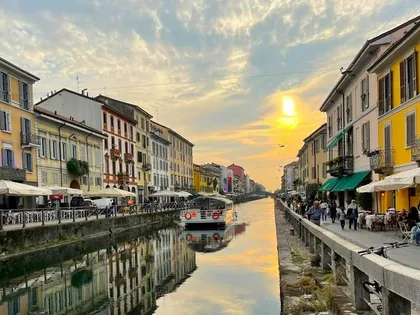

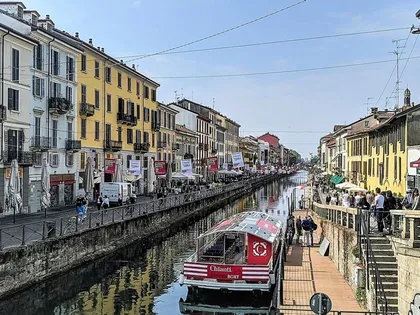
The Navigli in Milan are what survives of a medieval canal network that once floated marble, coal and rice into the middle of the city. Five canals made up the system — Naviglio Grande, Naviglio Pavese, Naviglio Martesana, Naviglio di Paderno and Naviglio di Bereguardo — and the first three met inside Milan in a ring canal called the Fossa Interna. Two still hold water in the city today: the Naviglio Grande and the Naviglio Pavese, joining at the Darsena basin. A boat tour of them costs €19 and takes about 50 minutes. Walking the same banks costs nothing, and for most people it is the better evening.
Three canals, one basin: what you are looking at
Naviglio Grande
Dug between 1177 and 1272, the Naviglio Grande runs 49.9 km (31 mi) from the Ticino river near Tornavento down to the Darsena. It falls only 34 m over that whole distance, which is exactly why the water in the city barely seems to move. Out in the countryside it is 22–50 m wide; by the time it reaches Milan it has narrowed to roughly 15 m.
That gentle gradient was the point. It let loaded barges be poled and towed upstream as well as down, and it is the reason a canal from the Alpine foothills could end in a city basin rather than a waterfall.
Naviglio Pavese
The Pavese leaves the Darsena heading south, 33 km to Pavia and the Ticino, stepping down through six locks. Work began in 1564, stopped about twenty years later just outside Milan because the engineering did not hold, and only finished in 1819 — the abandoned structure south of the city is still called the Conca Fallata, the “failed lock”. It closed to navigation in the 1960s.
The Darsena
The Darsena di Porta Ticinese is the basin where the two canals meet, and for centuries it was Milan’s working port: a landlocked city of a million people fed by barge. The basin is about 750 m long and 25 m wide, some 17,500 m² of water. It is now a paved promenade with bars along one side and a public park behind it — the result of an eighteen-month rebuild of the water, the banks and the moorings, finished for Expo 2015 and reopened on 26 April that year, which also pedestrianised the southern embankment and gave Piazza XXIV Maggio its covered market.

Leonardo and the locks
The lock system is what made the network usable, and it is where Leonardo da Vinci enters the story: he worked on lock design during his years in Milan. Two locks linking the Sant’Eustorgio basin to the inner ring let barges carry Candoglia marble to Piazza Santo Stefano for the building of the Duomo di Milano, begun in 1386. If you want the machines rather than the canals, both Leonardo museums cover his hydraulic work.
Where the rest of the water went
The canals people expect to find in the centre are not there. The Inner Ring, along with the urban stretch of the Naviglio Martesana, was covered over at the beginning of the 1930s. What you walk on in the historic centre is roadway laid over water. A long-running municipal debate about reopening parts of it resurfaces every few years. The Comune di Milano’s Progetto Navigli sets out a first phase of five stretches totalling about 2 km, and it went through a formal public debate back in 2018. It has not been built: cost is the sticking point, and no start date exists. Nothing you can walk on will have changed by your trip.
Navigli Milan boat tours: what you get for €19
The city tour is short and fixed: about 50 minutes out along the Naviglio Grande and into the Darsena and back, on a low electric boat, with a recorded commentary. Tiqets sells it at €19 with an audio guide in Italian, English, German, French, Spanish and Portuguese, and one drink if you pick that option; GetYourGuide’s version is €22 for the same 50 minutes with a QR-code commentary on board. Both depart from Alzaia Naviglio Grande 4. Prices checked September 2026.
Same ticket, two booking sites
Live prices from Tiqets and GetYourGuide. Tap a button to open the listing.
| Site | Price | Rating | Duration | Cancellation | Book |
|---|---|---|---|---|---|
| Tiqets Milan: Navigli and Darsena Boat Tour Lowest price | €19per person | ★ 3.0197 reviews | 50 min | Free cancellation | Book on Tiqets |
| GetYourGuide Milan: Navigli Canal Boat Cruise Best rated | €22per person | ★ 3.45,829 reviews | 50 min | — | Book on GetYourGuide |
What you actually see from the water:
| Along the route | Worth the seat? |
|---|---|
| Case di ringhiera — the balconied working-class courtyard blocks | Yes, they read better from the canal than the street |
| The Vicolo dei Lavandai washhouse | Barely — it faces the alley, not the water |
| Bar terraces, bridges, moored boats | Pleasant at dusk, ordinary at midday |
| Warehouse backs and blank walls on the far bank | The honest majority of the route |
| The Darsena basin and its promenade | The best few minutes of the trip |
The honest rating note
Say it plainly: these tours sit at roughly 3 to 3.5 out of 5, across thousands of reviews on both platforms. That is unusually low for a Milan product and it is not a fluke. Three reasons:
It is a canal, not a cruise. The water is flat and slow by design, the banks are low and close, and much of the far side is the back of buildings. There is no opening view, no skyline, no lake.
You sit below the parapet. The boat rides low, so for stretches you are looking at brickwork at eye level rather than the street life that makes the district enjoyable.
Fifty minutes is short, and part of it is the turn. The route goes out and comes back the same way, so the second half repeats the first.
Book it anyway if you want an hour off your feet with a drink in hand, if you are travelling with someone who cannot walk the towpath, or if it is raining — the boats are covered. Skip it if you were expecting scenery, and put the €19 towards the aperitivo version or a food tour.
The aperitivo cruise: the version that works
Same boat, same 50 minutes, different point. At €33 on Tiqets you get a drink of your choice — red, white, spritz or non-alcoholic — plus a plate of sweet and savoury canapés; GetYourGuide’s equivalent is €35. The ratings are marginally better than the plain tour, which tells you the drink is doing the work.
Same ticket, two booking sites
Live prices from Tiqets and GetYourGuide. Tap a button to open the listing.
| Site | Price | Rating | Duration | Cancellation | Book |
|---|---|---|---|---|---|
| Tiqets Aperitif by boat on the Navigli Lowest price | €33per person | ★ 3.582 reviews | 50 min | Free cancellation | Book on Tiqets |
| GetYourGuide Milan: Navigli District Canal Boat Tour with Aperitivo Best rated | €35per person | ★ 3.54,029 reviews | 50 min | — | Book on GetYourGuide |
Book the last departure before sunset. The canal is dull in flat afternoon light and good for the twenty minutes when the bar lights come on and the water turns dark. Both versions offer free cancellation up to 24 hours ahead, so a weather hedge costs nothing.
Walk it instead: a 90-minute route
This is the version to do first. It is free, it goes at your pace, and it passes the things the boat cannot reach.
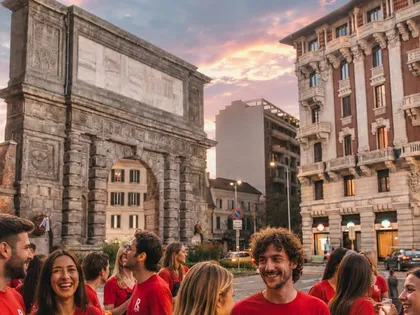
- Colonne di San Lorenzo — sixteen Roman columns re-erected in front of the basilica, and the informal meeting point for half of student Milan. Start here around 18:00.
- Porta Ticinese — the 19th-century gate, then straight down to the water.
- Darsena — walk the full length of the basin on the market side. This is your orientation point: Naviglio Grande to the right, Naviglio Pavese to the left.
- Vicolo dei Lavandai (Alzaia Naviglio Grande 14) — the surviving public washhouse, in use from the 1800s until the 1950s. Its Milanese name was Vicol de Bugandee, from bugada, laundry. Washers knelt on wooden boards under a roof, rinsed in a channel fed by the Naviglio Grande and scrubbed against stone. A confraternity of male lavandai ran the trade from the 18th century; women largely took over during the Second World War.
- Naviglio Grande towpath west — 20–30 minutes as far as you like. The bars thin out and the case di ringhiera take over.
- Cross and come back on the far bank, then finish on the Naviglio Pavese, which is quieter and cheaper for a drink.

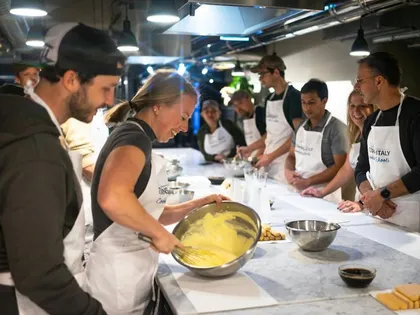
Want the history narrated? A free walking tour covers the Roman and canal city, and there are small-group night walks that end down here.
The antiques market: last Sunday of the month
The Mercatone dell’Antiquariato takes over the Naviglio Grande on the last Sunday of every month, running from viale Gorizia to the bridge on via Valenza — around two kilometres of stalls on the canal banks, with more than 380 exhibitors and, by the organisers’ own count, 35,000 to 50,000 visitors. It is furniture, prints, jewellery, vinyl and a fair amount of ordinary bric-à-brac.
Go early. By noon the towpath is a slow-moving single file, and the boats stop being fun. The organisers’ 2026 calendar skips no month — twelve dates plus a one-off extra edition for the Winter Olympics in February — but they do not publish set opening and closing times, so treat it as a daylight market: stalls building from early morning and packing down through the afternoon.
Timing is everything
| When | What it is like |
|---|---|
| Weekday 10:00–16:00 | Empty, quiet, half the bars shut. Good for photographs of the washhouse, poor for atmosphere |
| Any day 18:00–20:00 | The reason to come. Aperitivo hour, full terraces, best light on the water |
| Friday and Saturday after 22:00 | Very crowded and loud, largely a young local scene |
| Last Sunday of the month | Antiques market — arrive before 10:00 |
| July and August | Hot, still air over the canal and many places closed for the holidays |
| November to February | Cold and often foggy; the walk still works, the boat much less so |
How to get there
Metro: M2 (green) to Porta Genova FS puts you two minutes from the Naviglio Grande; M2 Sant’Agostino is a similar walk. For the Naviglio Pavese side, M2 Porta Genova or M3 (yellow) to Porta Romana.
Tram: tram 9 terminates at Porta Genova, two minutes from the Naviglio Grande, and tram 10 terminates in Piazza XXIV Maggio, which is the Darsena itself. Tram 3 runs down from Duomo through Porta Ticinese on the same axis.
On foot: about 25 minutes south-west from Piazza del Duomo via the Colonne di San Lorenzo, and roughly 20 minutes from the Castello Sforzesco via Sant’Ambrogio.
Tickets: one ATM urban ticket is €2.20 and covers 90 minutes on metro, tram and bus. See tickets and passes for day tickets.
Combine it with
The Navigli sit at the bottom of the same axis as the Duomo and the Last Supper, so the standard good day is museums until late afternoon and canals from six. Santa Maria delle Grazie is 15 minutes north-west; Fondazione Prada is 15 minutes east by tram. For the wider evening — Brera, Isola, clubs, last metro times — see nightlife and aperitivo.


Walk the Navigli in Milan first and decide about the boat afterwards, from a bar stool on the towpath with the thing in front of you. If you still want the water, take the aperitivo cruise at sunset rather than the plain daytime tour — same canal, same 50 minutes, considerably better value for the money.
Book the Navigli aperitivo cruise from €33 · ★ 3.5 · Tiqets
Questions people ask
01How much is a Navigli boat tour in Milan?
From €19 per person on Tiqets for a roughly 50-minute canal and Darsena tour with a multilingual audio guide, or €22 on GetYourGuide. The aperitivo version with a drink and canapés is €33–€35. Prices checked September 2026.
02Is the Navigli boat tour worth it?
For most visitors, no — it averages around 3 to 3.5 out of 5 across both platforms. It is a slow, flat, walled canal rather than a scenic cruise, and you see more from the towpath. Book it if you want to sit down with a drink for an hour, not for the views.
03Can you walk along the Navigli for free?
Yes. The towpaths along both the Naviglio Grande and the Naviglio Pavese are public streets, open at all hours and free. The Vicolo dei Lavandai washhouse and the Darsena basin cost nothing to see.
04When is the Navigli antiques market?
The Mercatone dell'Antiquariato runs on the last Sunday of every month along the Naviglio Grande, from viale Gorizia to the bridge on via Valenza — roughly two kilometres of stalls, with more than 380 exhibitors.
05How do I get to the Navigli from the Duomo?
Take metro M2 (green) to Porta Genova FS, or M3 to Porta Romana and walk west. From Piazza del Duomo it is about a 25-minute walk south-west via the Colonne di San Lorenzo and Porta Ticinese.
06What is the difference between the Naviglio Grande and the Naviglio Pavese?
The Naviglio Grande is the older and busier one — dug from 1177, 49.9 km from the Ticino river to the Darsena, and lined with most of the bars. The Naviglio Pavese runs 33 km south from the Darsena towards Pavia, is quieter, and has six locks.
07Is the Navigli area safe at night?
It is busy and well lit until late, and crowds are dense on Friday and Saturday. Treat it like any packed nightlife district: watch bags and phones in the crush on the bridges, and plan your ride home before the metro closes.
Sources & official pages
- Mercatone dell'Antiquariato sul Naviglio Grande
- Naviglio Grande – history and dimensions
- Naviglio Pavese – history and locks
- Vicolo dei Lavandai
- YesMilano – official city tourism site
- ATM – Milan public transport
- ATM – tickets and fares
- Mercatone dell'Antiquariato – 2026 calendar
- Darsena di Porta Ticinese – dimensions and the 2015 rebuild
- Comune di Milano – Progetto Navigli, public debate and project documents
- Milan tram network – line list
Read next
- Nightlife & aperitivoHow aperitivo works in Milan, which districts suit which night, opera and live music, evening tours from €6, and how to get home after the metro shuts.
- Things to doThe 20 best things to do in Milan, ranked and priced: Duomo terraces, the Last Supper, La Scala, Navigli and more, plus 1, 2 and 3-day plans.
- Milan toursEvery kind of Milan tour compared: walking, Last Supper combos, Duomo guided, food, bike and night. Real prices, durations and ratings. Book direct.
- Free toursHow free walking tours in Milan actually work, who runs them, what the routes cover, how much to tip, and when a paid tour or ticket is the better buy.